
Hook
You’ve embraced RAG—but you still face hallucinations, rigid pipelines, or opaque logic. Agentic RAG and Graph RAG promise smarter, more transparent AI. Which fits your use case?
What Is Traditional RAG
RAG (Retrieval-Augmented Generation) links an LLM with a knowledge base. It retrieves documents—often via vector search—and uses them to ground generation. Solid for static Q&A, but limited in adaptability, validation, and tool use.
Agentic RAG: Reasoning, Planning, Acting
Core Concept
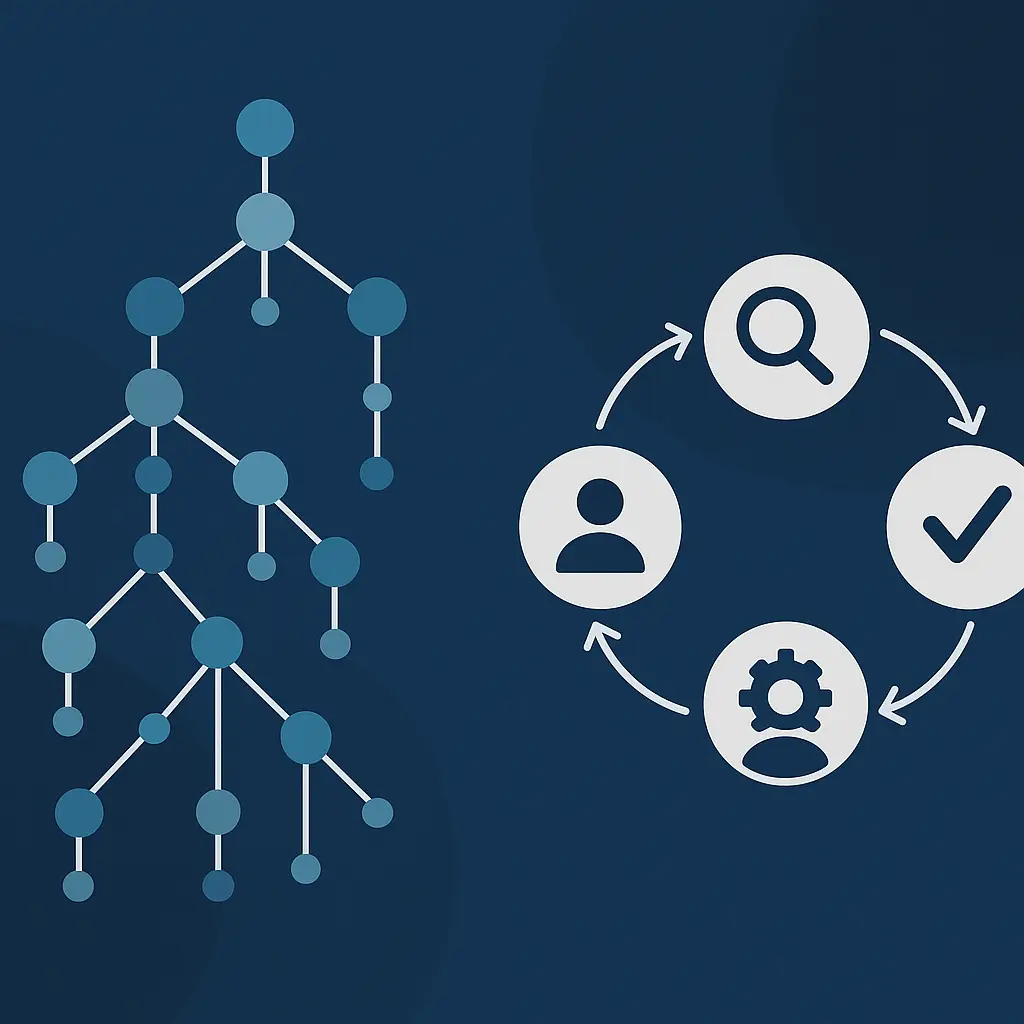
Agentic RAG adds a layer of AI agents that plan, decide, retrieve, validate, and refine. It transforms retrieval from a one-and-done step into a multidimensional, evolving process. These agents can call APIs, route queries, and adjust workflows. Agentic RAG excels when contexts shift or workflows are complex. [IBM, Salesforce]
How It Works
- Query Analysis: Agents interpret the user’s intent, refine unclear queries, or break them into sub-queries [GeeksforGeeks].
- Tool-Driven Routing: Agents select whether to use vector search, APIs, databases, calculators, or web access [Weaviate, Progress].
- Iterative Retrieval: If context is insufficient, the agent retries with reformulated queries or alternative sources [Qodo].
- Validation & Traceability: Agents can validate results and log steps for audit and transparency—crucial in regulated sectors [Progress].
Benefits & Constraints
- Flexibility in sources and workflows
- Better context, fewer hallucinations
- High transparency and traceability
- Resource intensive: agents cost compute and introduce latency [IBM, Gartner]
- Complexity and implementation overhead
Graph RAG: Structured Knowledge at Core
Graph RAG leverages knowledge graphs: entities and relationships rather than flat document chunks. It offers structured reasoning paths and insights—in effect, it maps connections, not just retrieves facts. [Progress]
Agentic Graph RAG
Agentic Graph RAG combines agents with knowledge graphs. Agents traverse graph structures, plan retrieval over relations, and reasons over entity paths. A recent model—Graph‑R1—employs reinforcement learning to optimize graph traversal and generation, improving both retrieval accuracy and reasoning fluency [arXiv, Jul 2025].
Benefits
- Preserves semantic and relational structure
- Improved accuracy via graph-aware reasoning
- Transparent reasoning trails
- More efficient than vanilla graph RAG when well-trained [arXiv]
Comparative Breakdown
| Feature | Agentic RAG | Graph RAG / Agentic Graph RAG |
|---|---|---|
| Knowledge Structure | Unstructured or semi-structured sources | Structured entities and relationships |
| Reasoning Approach | Agent-driven, multi-step workflows | Agents traverse graphs, optimized via RL |
| Transparency | Audit trails and validation | Structured reasoning paths are inherently traceable |
| Complexity | High orchestration and tooling demands | Even higher, due to graph modeling and RL training |
| Best For | Dynamic, multi-source tasks | Complex queries needing structured relational understanding |
Where They Shine
- Agentic RAG: Ideal for dynamic environments (customer service, real-time support, R&D workflows) [Salesforce, IBM, Qodo].
- Agentic Graph RAG: Fits scenarios demanding relations and inference—legal, research, scientific domains—where accuracy and structure matter [arXiv].
Emerging Trends & Risks
- Despite promise, roughly 40% of agentic AI projects may fail by 2027—cost and unclear ROI are key hurdles [Gartner, June 2025].
- Graph-based RAG via agentic frameworks is nascent; models like Graph‑R1 show early promise but require expertise and fine-tuning [arXiv, Sept 2025].
- Security: Agentic models querying live systems can preserve access controls better than traditional RAG. That’s why enterprises moving away from RAG looked toward agent-based architectures for safety and compliance [TechRadar, Jul 2025].
Choose Wisely
If you need adaptability across data silos and robust, evolving workflows, Agentic RAG is a powerful option. If your questions require understanding of entity relationships and multi-step inference, Agentic Graph RAG can elevate reasoning. Both need planning and resources—but the payoff is smarter, more trustworthy AI.
Conclusion
Agentic RAG brings reasoning and tool use to RAG. Graph RAG structures knowledge. The hybrid—Agentic Graph RAG—optimizes both. Choose based on your data complexity and reasoning demands.
Projectchat.ai offers multimodal chat with all providers, image generation models, and agentic/hybrid RAG over your own data—with specific workspaces and projects. Try it now: https://projectchat.ai/trial/